Winner Product in Ecommerce: How to Find, Compare, and Validate a Product

The phrase winner product is popular in ecommerce, but it can create the wrong expectation. A product is not a winner because a video is popular, a supplier calls it a bestseller, or another store displays it with a large discount. It becomes a stronger business candidate when a specific audience understands the offer, the economics leave room for costs, the seller can fulfill it consistently, and real order outcomes support the hypothesis.
This guide presents a practical way to find and validate a potential winner product. It compares the main product families, explains their advantages and limitations, and uses a fictional Algerian store with hypothetical numbers. The objective is not to promise sales or a guaranteed conversion rate. It is to replace intuition alone with a sequence of checks you can repeat.
What is a winner product?
A winner product is a working commercial hypothesis: a product with a clear use case, a reachable audience, a price that can support the business, and evidence that people take meaningful steps toward buying it. The word “winner” should describe the current strength of the evidence, not a permanent label.
Separate three ideas:
- A trending product receives attention or search interest. Attention can be short-lived and may not lead to orders.
- A potentially profitable product has a price and cost structure that could leave a contribution margin after product, packaging, delivery, advertising, payment, support, returns, and failed deliveries.
- A validated product has been tested under defined conditions, with a known audience, a clear page, a consistent offer, and order statuses that you can reconcile.
The same item can be trendy but unprofitable, profitable on paper but impossible to deliver, or validated for one audience and weak for another. This is why copying a competitor’s catalogue is not a product-research method by itself.
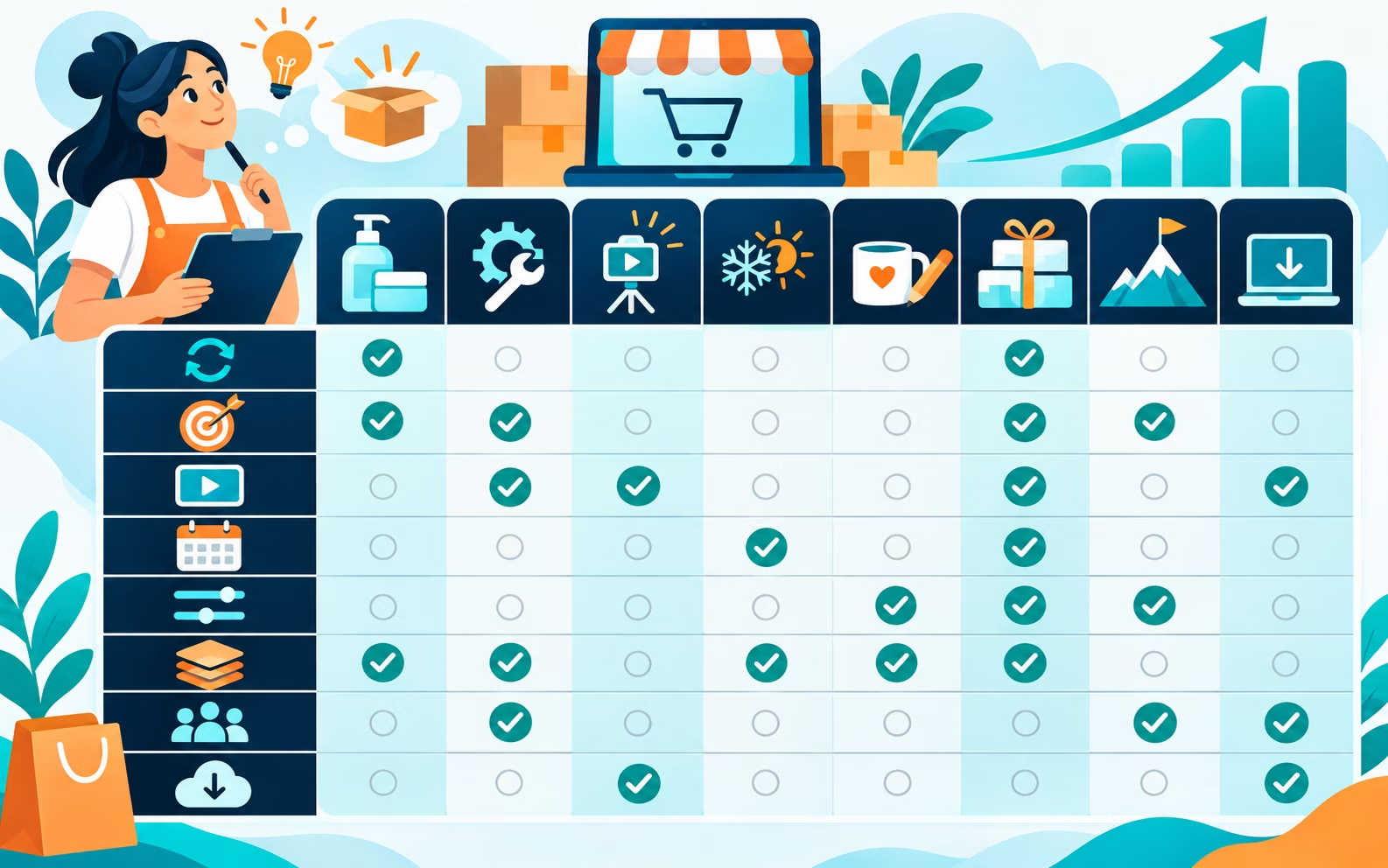
Compare the main ecommerce product families
There is no universal list of every product type. The following families are useful because each creates a different research and operations question.
Consumables and repeat-purchase products
Examples include household refills, personal-care supplies, food-related items, and other products that customers may buy again.
Advantages: repeat demand can support retention, bundles, and predictable reorder conversations. A small first purchase may become a longer customer relationship.
Limitations: quality, expiry, storage, safety, and trust matter. Margins may be modest, and a seller may need reliable replenishment. Local regulations and product claims must be checked before publication.
Ask whether the customer has a real reason to reorder, whether the product can be stored correctly, and whether your support process can answer questions about use and composition.
Problem-solving products
These products address a concrete inconvenience: organizing a space, protecting an object, simplifying a routine, or making a task easier.
Advantages: the problem can give the product a clear message and a useful demonstration. Search questions and customer conversations can reveal the language people use.
Limitations: the problem must be real, and the solution must match its boundaries. Avoid fear-based claims, medical promises, or language that shames the customer. If the item only helps in a narrow situation, explain that situation precisely.
Demonstrable products
These products show their value through an action: a tool in use, a transformation of an arrangement, or a comparison of before and after use.
Advantages: a short video or carousel can make the use case easy to understand. Demonstration can reduce the gap between an advertisement and the product page.
Limitations: a staged demonstration can mislead if the result depends on conditions the buyer will not have. Show scale, included accessories, effort, and limits. A satisfying video is not proof of demand or margin.
Visual and impulse-oriented products
Fashion accessories, decor, gifts, and visually distinctive objects can attract attention quickly.
Advantages: strong photography, styling, and social content can help a shopper notice the item. A gift angle or a clear occasion may create a focused audience.
Limitations: preference is subjective, trends change, and returns can be higher when color, size, or texture is misunderstood. Accurate photos, dimensions, options, and delivery timing are essential.
Seasonal products
Products connected to a holiday, weather pattern, school period, event, or local occasion may have a short but relevant window.
Advantages: the occasion gives the content a natural context and can make planning more concrete.
Limitations: the selling window can close before stock arrives. Forecasting is uncertain, and leftover inventory may lose value. Test lead time, supplier reliability, and demand before buying a large quantity.
Personalized products
Names, colors, messages, sizes, or designs can make an offer more distinctive.
Advantages: customization can improve perceived relevance and reduce direct price comparison.
Limitations: each option adds production, approval, support, and return complexity. A spelling error or unclear preview can create a costly problem. Define what can be changed, when production starts, and what happens if the customer does not confirm details.
Bundles and kits
A bundle combines complementary items into one offer: a starter kit, a care set, or a gift pack.
Advantages: bundles can raise the value of an order and make the use case easier to explain. They can also move related stock together.
Limitations: one unavailable component can block the whole bundle. Calculate the cost of every item, packaging, preparation time, and replacement. State what is included instead of relying on a styled photo.
Niche and compatibility products
These products serve a specific activity, device, profession, size, or community.
Advantages: a narrow audience can make the problem and language more precise. Compatibility questions can create strong buying intent.
Limitations: the audience is smaller and returns can be costly when a model or measurement is misunderstood. Publish a compatibility list, dimensions, exclusions, and a way to ask before ordering.
Digital products and services
Templates, consultations, courses, subscriptions, and tools do not require physical delivery in the same way.
Advantages: no warehouse or parcel loss can simplify fulfillment. Updates and support can become part of the offer.
Limitations: trust, access, refund terms, support capacity, and the difference between a promise and a usable result are critical. A digital product still needs a specific audience and a clear outcome; “make more money” is not a sufficient product description.
Start research with a customer situation
Do not begin by asking only, “What is selling?” Begin with a situation you can investigate:
- What task is difficult, slow, confusing, or poorly served?
- Who experiences it, and how often?
- What do people currently use or improvise?
- What objections would stop an order?
- Can you source, explain, deliver, and support a solution?
Look for repeated questions in customer conversations, marketplace reviews, search suggestions, social comments, community discussions, and supplier catalogues. These sources generate hypotheses; they do not prove local demand. Record the exact wording, the audience, the date, and the source so that you do not confuse one loud post with a market.
The guide to starting an online store with Madabina helps turn a promising idea into a small, complete catalogue. Keep the first collection small enough to describe accurately and fulfill.
Score the opportunity before buying stock
Create a simple scorecard. Use a scale such as 1 to 5, define what each score means, and write a note beside every score. Useful dimensions include:
- evidence of a relevant demand or problem;
- clarity of the audience and differentiation;
- expected selling price and contribution margin;
- product weight, fragility, storage, and packaging;
- supplier reliability and sample quality;
- legal, safety, warranty, or compatibility risk;
- competition and the ease of comparing prices;
- content and demonstration potential;
- delivery coverage and customer-support capacity.
Do not let one high score hide a blocking risk. A light product with an excellent video is not a good candidate if its supplier cannot provide consistent quality. A high margin is not useful if the item is frequently refused at delivery.
Check supplier, cost, and contribution margin
Request a sample when possible. Check the actual dimensions, materials, colors, packaging, instructions, and defects. Ask about minimum order quantity, replenishment time, variations between batches, and what happens when a component is unavailable. Never publish a claim based only on a supplier title.
Use a contribution-margin estimate rather than the purchase price alone:
selling price - product cost - packaging - delivery cost - payment cost - advertising cost per created order - expected failed-delivery cost - support and return allowance
Suppose a fictional Algerian store considers a reusable organizer. The example selling price is 2,900 DZD, product and packaging cost 1,050 DZD, average delivery and handling 450 DZD, and a hypothetical advertising cost of 500 DZD per created order. Before any allowance for confirmation failures, returns, taxes, or other operating costs, the remaining amount is 900 DZD. That is not a guaranteed profit; it is a prompt to complete the model with the store’s real costs and delivery outcomes.
If the margin only works when the advertising cost is unrealistically low or every parcel is delivered, the product is not ready to scale. Test the assumptions with a small quantity and preserve enough cash for replacements and customer service.
Build a page and creative that agree
The product page checklist is the proof layer for the offer. Check the product name, real photos, dimensions, options, stock, price, delivery information, included items, order form, and mobile layout. A product that looks interesting in an ad still needs a page that answers the buyer’s questions.
For the creative, show one situation, one useful product detail, one proof point, and one next step. Use the page for the full specification. If the ad shows two colors, the page must offer those colors. If the ad promises a bundle, the page must list every component. If the price or delivery condition changes, update the message.
Madabina’s AI product assistant article can help prepare drafts, images, or a landing page for eligible workflows. Review every generated name, image, option, price, translation, and claim against the real item before publishing. AI can accelerate preparation; it does not validate the product.
Test the hypothesis one variable at a time
A first test should answer one question. Examples:
- Does a problem-focused creative attract more qualified product-page visits than a demonstration?
- Does a dimension-focused page reduce pre-order questions?
- Does a bundle raise the average order value without increasing refusals?
- Does a different audience produce more confirmed and delivered orders, not only more clicks?
Keep the product, price, stock, delivery promise, and order process stable when comparing a creative. Record the date range, spend, audience, URL, creative version, clicks, page visits, created orders, confirmed orders, delivered orders, cancellations, returns, and costs.
The COD media-buying guide explains why a platform conversion and a delivered COD order are different measures. A fictional test might show 1,200 impressions, 55 clicks, 10 created orders, 7 confirmed orders, and 4 delivered orders. Those values are hypothetical observations for one period, not a universal benchmark and not proof that the product will keep performing.

Decide what to do after the test
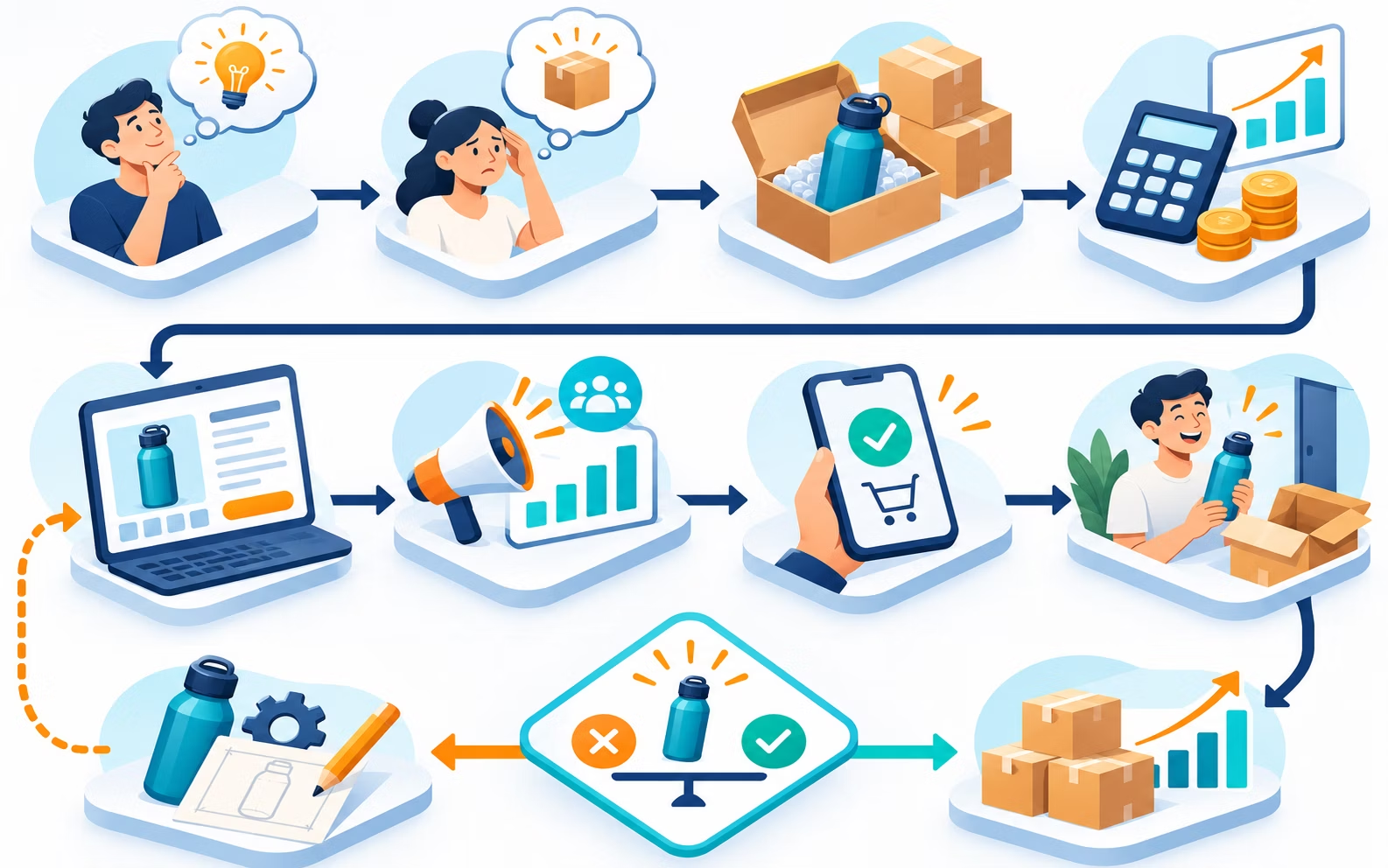
Use the evidence to choose one of four actions: continue the same test, improve the page or offer, change the audience or creative, or stop the product. A high click rate with few page interactions can indicate a promise mismatch. Many page visits with no orders can indicate price, trust, information, or delivery friction. Created orders without confirmation can indicate an operational or expectation problem. Confirmed orders without delivery can expose a delivery, contact, or product-quality issue.
Do not call a product a winner from one metric. Look for a coherent pattern across demand, economics, customer questions, stock, and fulfillment. When the evidence is weak, stopping early can protect cash and make room for a better hypothesis.
Winner-product checklist
- Define the audience, situation, problem, and product promise.
- Classify the product family and write its specific advantages and risks.
- Find evidence from several sources without treating attention as demand.
- Request or inspect a sample and verify the supplier’s claims.
- Calculate contribution margin with delivery, advertising, returns, and support included.
- Prepare a complete mobile product page and an honest creative.
- Test one meaningful variable at a time.
- Separate clicks, page visits, created orders, confirmed orders, and delivered orders.
- Keep notes on the conditions of each test and avoid universal conclusions.
- Stop or revise the offer when stock, margin, support, or delivery cannot sustain it.
When the offer is ready, create a Madabina merchant account and publish a small catalogue you can describe, support, and fulfill accurately. Madabina can help you prepare a storefront and product workflow; the validation of a product remains a merchant decision based on real customers and real operations.