From Algeria’s 1 November legacy to its digital future

On 1 November 2026, Algeria marks 72 years since the start of the 1954 Revolution of Liberation. The anniversary invites remembrance of the people who struggled for national independence and reflection on the kind of country later generations can build. Technology and commerce cannot be equated with that struggle. They can, however, be part of a practical conversation about skills, opportunity, and the future of the Algerian economy.
The Algeria Press Service’s anniversary report records the 72nd anniversary of 1 November 1954. Remembering this date can also prompt a forward-looking question: how can people across the country create useful services, businesses, and technology with knowledge developed locally?
A digital economy is built through everyday capabilities
Digital transformation is more than putting a paper process on a screen. It depends on dependable infrastructure, people who can design and maintain systems, clear rules, useful services, and the confidence of the people who use them. Algeria’s national digital transformation strategy toward 2030 identifies infrastructure, human capital and training, digital governance, the digital economy, and digital society among its main areas of work, as reported by the Algeria Press Service.
That framework matters to people outside technology companies. A shop owner needs clear product information and a reliable way to answer customers. A developer needs to build services that work on common devices and connections. A delivery team needs accurate order details. A customer needs to understand the price, terms, and next step. Each role contributes to whether a digital service is genuinely useful.
E-commerce connects local work with digital tools
An online store can help a small business present its products beyond the people who pass its physical location. But publishing a product page is only one part of the work. Sustainable commerce also asks for accurate descriptions, stock that reflects reality, clear delivery choices, customer support, and a dependable process for handling orders and returns.
These needs create practical work around digital commerce: product photography and writing, interface design, web development, catalog management, customer service, operations, and delivery coordination. They also make reliability and trust central. Businesses should communicate what they can provide, and shoppers should be able to understand what they are ordering.

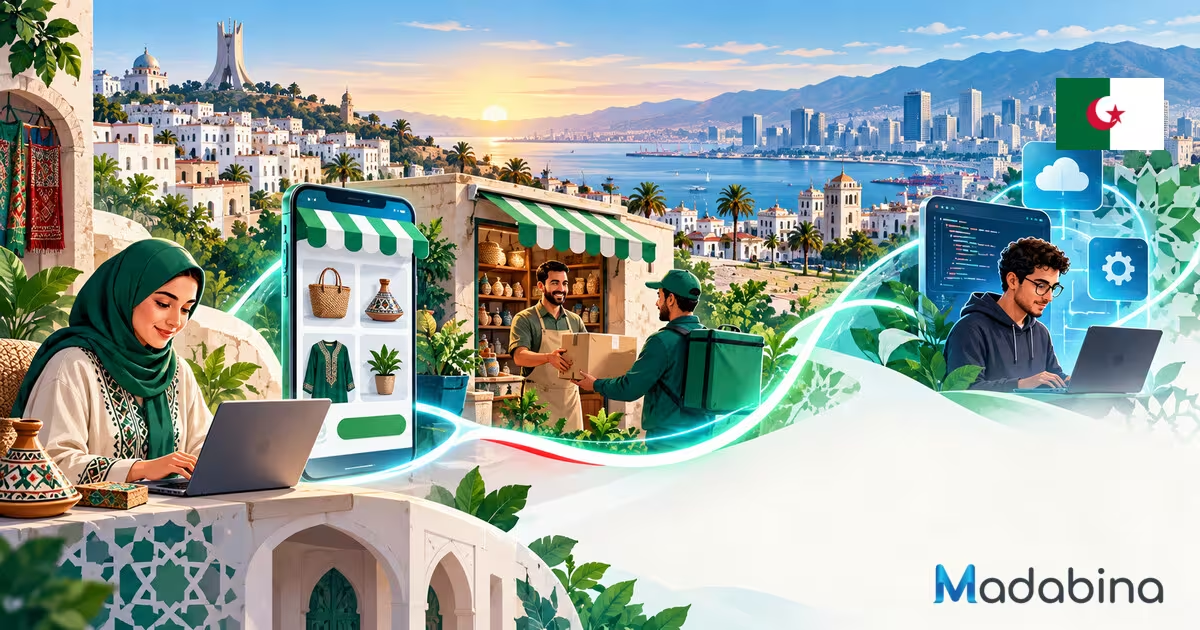
This generated editorial image illustrates an everyday commerce scenario; it does not depict a specific business or person.
Algeria’s Ministry of Commerce publishes Law No. 18-05 on electronic commerce, a primary reference for the legal framework. Businesses should consult the current text and relevant authorities for their own obligations; this article is not legal advice.
What the shared Google Trends captures can—and cannot—show
The screenshots shared for this article show Google Trends results for the search term “ecommerce” in Algeria over a long period, along with regional interest and related queries. They suggest that people are searching for information connected to online commerce and website development. They do not tell us how many stores are operating, how much they sell, or how many searches lead to a purchase.
Google explains that Trends values are normalized to the selected time and geography and scaled from 0 to 100; they represent relative search interest, not absolute search counts. The screenshots also list Blida, Tipaza, M’Sila, Aïn Defla, and El Oued among the regions with the highest relative interest for this query. Read those rankings as a clue for further questions—not as a measure of population-wide demand or commercial activity. See Google’s explanation of Trends data.

A summary of the supplied Google Trends screenshots, not a market-size estimate or a reconstruction of exact search volumes.
Turning interest into useful local services
Search interest can help entrepreneurs and developers choose what to investigate next. Which products are difficult to find? What questions do shoppers ask before placing an order? Which parts of the online journey are confusing? Answers should come from conversations, careful observation, and actual service results—not from a trend chart alone.
For a merchant, a useful first step is to prepare a small, accurate catalog and a delivery process that can be fulfilled. Madabina’s guide to starting an online store in Algeria walks through store, product, order-form, and delivery preparation. Its practical online-store marketing plan covers how to communicate an offer and learn from customer questions.
The future of Algeria’s digital economy will depend on many people and institutions working over time. Remembering 1 November can be a moment to value what previous generations made possible and to take responsibility for the useful, trustworthy work that remains ahead. Local technology becomes meaningful when it helps people solve real problems and participate in an economy that serves them.